01↗
Web Applications
Custom browser-based products, dashboards and operational systems with purpose-built interfaces.
- Dashboards
- Admin systems
- SaaS applications
- Data workflows
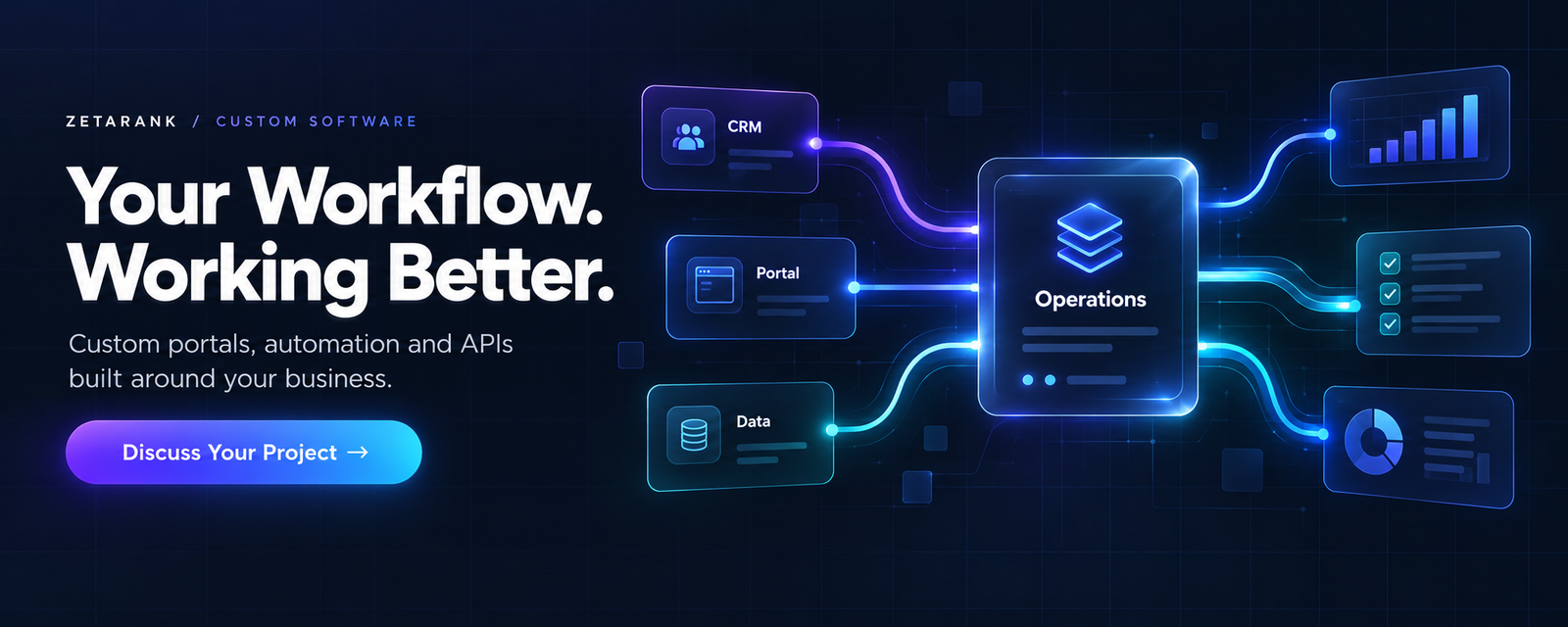
We design and engineer custom web applications, internal platforms, portals, automation and integrations for workflows that off-the-shelf software cannot handle cleanly.
We start with the process, users, data and constraints before choosing the architecture. The goal is software that simplifies work, connects disconnected systems and gives teams better control over critical operations.
That can mean replacing spreadsheets, connecting APIs, creating a customer portal or building a complete application from the ground up.
From focused internal tools to customer-facing platforms, we design around the business problem rather than forcing a generic product into the gap.
Custom browser-based products, dashboards and operational systems with purpose-built interfaces.
Replace repetitive manual steps with reliable workflows that move information between teams and systems.
Secure experiences where customers, vendors or partners can access data, submit information and manage activity.
Connect CRMs, ecommerce platforms, payment services, internal databases and third-party APIs.
Replace fragile spreadsheets and disconnected admin processes with software built for your team.
Improve or rebuild aging applications where architecture, performance or maintainability has become a constraint.
Good software architecture makes future changes easier. We separate responsibilities, define integrations clearly and plan for permissions, data integrity, failure states and maintainability from the beginning.
Complex software benefits from early clarity. We define workflows and architecture before spending development time on the wrong solution.
Map the problem, users, current workflow, data sources and operational constraints.
Turn requirements into user journeys, system boundaries and a prioritized product scope.
Validate important interfaces and workflows before committing to full implementation.
Build the application, integrations, permissions, data layer and automated workflows.
Test real scenarios, edge cases, security boundaries, performance and data behavior.
Release, observe usage and improve the system as requirements and operations change.
The architecture depends on the application, existing systems, team and deployment requirements. We prefer established technologies with strong ecosystems and clear maintenance paths.
Manual processes are becoming difficult to control, audit or scale across the team.
Teams repeatedly copy information between tools or maintain duplicate sources of truth.
The business keeps working around limitations instead of the software supporting the real process.
A focused first version can test the core workflow before investing in a larger platform.
We first define the problem, workflows, integrations, major requirements and unknowns. For complex projects, a discovery phase is often the safest way to establish scope and reduce estimation risk.
Yes. A focused MVP can validate the most important workflow or product assumption before expanding into a larger system. We prefer an MVP that is deliberately scoped rather than a rushed version of every feature.
Yes. Integration work can include APIs, webhooks, CRMs, ecommerce systems, payment providers and internal databases, subject to the capabilities and access provided by those systems.
Yes. We can assess an existing codebase and determine whether targeted improvements, refactoring or a staged rebuild is the more practical path.
Software usually evolves after real users begin working with it. Ongoing development can cover new features, integrations, performance work, maintenance and iterative product improvements.
Tell us what your team is doing manually, which systems need to connect, or what product you want to bring to market.